In short
- California's construction toilet rule requires employee toilet facilities, requiring nonwater facilities when sewer or water limitations make water closets infeasible.
- Crew size affects minimum facilities under the federal construction sanitation rule.
- Public use changes accessibility planning because the ADA Standards distinguish toilets exclusively for construction personnel from other portable toilets.
Construction Site Toilet Requirements and Unit Planning
Employee sanitation rules address toilet facilities, while rental planning also covers the pad, access and service visits. Call with the worksite location and describe the work underway; the employer's safety lead can address the applicable rules alongside the rental discussion.
The Standard Unit for Workers
The standard unit is a rental option where workers need a toilet away from permanent facilities. California's program covers most private workplaces and state and local government employers, while federal OSHA retains specified jurisdictions, as described in OSHA's California State Plan overview. That distinction matters when comparing Cal/OSHA portable toilet requirements with federal wording.
For portable toilet requirements for workers, California section 1526(a) sets a minimum separate facility for each twenty employees, or fraction, of each sex. For fewer than five employees, the same section's exception permits a single all-gender toilet facility. Under temporary field conditions, section 1526(b) still requires at least a toilet.
Federal OSHA porta potty requirements likewise address employee sanitation: the federal table lists a facility for twenty or fewer employees, with separate seat-and-urinal provisions for larger workforces. The federal wording is also published as 29 CFR 1926.51. A construction site porta potty ratio should follow the applicable rule and facility arrangement, rather than a general event headcount.
The Accessible Unit for Public Use
The accessible unit needs an approach that people can use as well as suitable interior space. ADA section 203.2 exempts portable toilets exclusively for construction personnel from its toilet-facility and accessible-route provisions. For clustered portable toilets outside that exception, section 213.2 addresses accessible facilities and identification at each cluster. Tell the safety lead when visitors or the public will use the units; the crew-only exception has that specific boundary.
The Wash Station Beside the Toilet
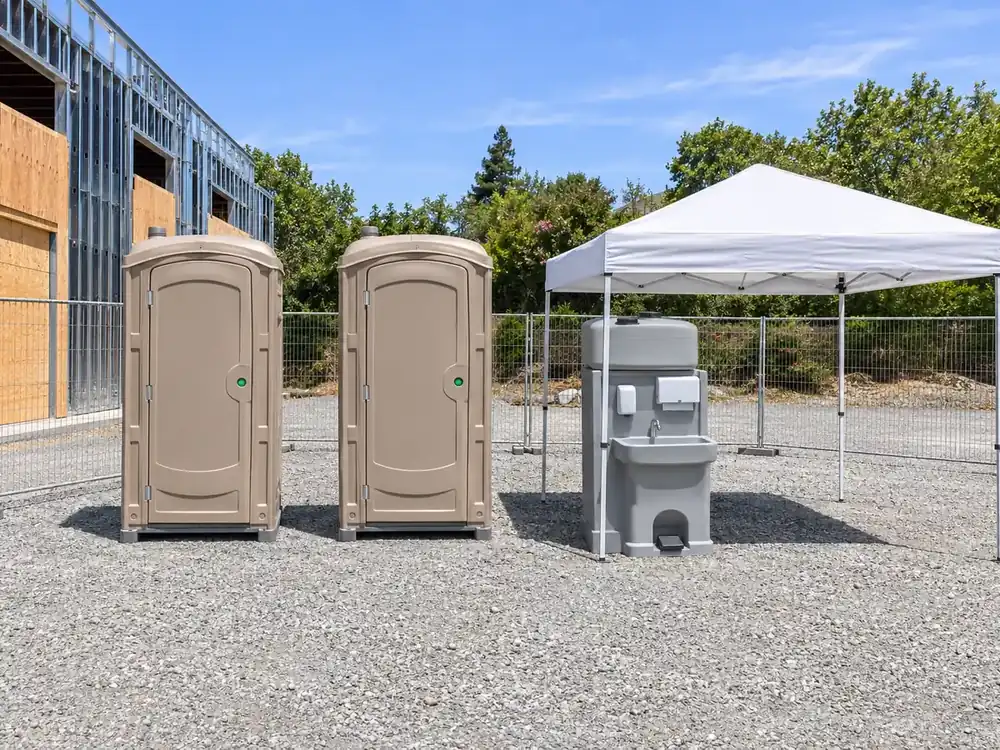
The wash station belongs in the facility plan alongside the toilet. California section 1527 requires a washing station for each twenty employees or fraction, with adequate water, soap or another suitable agent, and single-use towels or a warm-air blower. For nonwater toilets, that section generally places the washing facility outside and unattached, with an inside-location exception when fewer than five employees have only a single toilet.
Under federal section 1926.51(f), lavatories generally require hot and cold or tepid running water, cleansing supplies and hand drying; mobile crews and normally unattended locations have a transport-based exception. Describe the work and existing washing facilities during the call.
The Trailer Restroom and Delivery Access
The trailer restroom needs a placement discussion covering the tow route, pad, entrances and any required connections. A rental discussion should address the following decisions without assuming a trailer replaces every other facility.
| Unit | Placement discussion |
|---|---|
| Standard unit | Keep the door approach clear of stored materials. |
| Accessible unit | Plan the usable approach and entrance together. |
| Wash station | Preserve room to stand and use the basin. |
| Trailer restroom | Discuss turning space, steps and model-specific connections. |
Keep units on firm, level ground clear of vehicles, machinery, drains and overhead lines. A unit must stay in place, with no moving, tipping, lifting or climbing permitted. Tell your delivery pro about any problem with its position; they arrange service visits.
Responsibilities During the Rental
The employer's safety lead addresses rule interpretation; your delivery pro addresses the rental arrangement. Ask Cal/OSHA about California requirements or consult the linked OSHA text for federal provisions. Those rules do not select the rental model, name the delivery pro or establish a rental's service-visit schedule. Call to discuss the site, and one of our local portable sanitation partners will work through placement and rental terms with you.